Again When on a Time Sophocles Who Was His Fellowcommissioner
| Sophocles | |
|---|---|
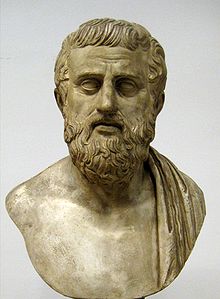 | |
| Born | 497/496 BC Colonus, Attica |
| Died | 406/405 BC (aged 90–92) Athens |
| Occupation | Tragedian |
| Genre | Tragedy |
| Notable works |
|
Sophocles (;[i] Aboriginal Greek: Σοφοκλῆς, pronounced [so.pʰo.klɛ̂ːs]; c. 497/six – winter 406/v BC)[2] is 1 of three aboriginal Greek tragedians whose plays have survived. His first plays were written later than, or contemporary with, those of Aeschylus; and earlier than, or gimmicky with, those of Euripides. Sophocles wrote over 120 plays,[3] but but seven take survived in a consummate course: Ajax, Antigone, Women of Trachis, Oedipus King, Electra, Philoctetes and Oedipus at Colonus.[4] For nigh 50 years, Sophocles was the most historic playwright in the dramatic competitions of the city-state of Athens which took place during the religious festivals of the Lenaea and the Dionysia. He competed in xxx competitions, won xx-4, and was never judged lower than second place. Aeschylus won xiii competitions, and was sometimes defeated past Sophocles; Euripides won four.[5]
The virtually famous tragedies of Sophocles feature Oedipus and Antigone: they are generally known as the Theban plays, though each was part of a unlike tetralogy (the other members of which are now lost). Sophocles influenced the evolution of drama, nigh importantly by adding a tertiary histrion (attributed to Sophocles by Aristotle; to Aeschylus by Themistius),[6] thereby reducing the importance of the chorus in the presentation of the plot.[ citation needed ] He also adult his characters to a greater extent than earlier playwrights.[7]
Life [edit]

A marble relief of a poet, perhaps Sophocles
Sophocles, the son of Sophillus, was a wealthy member of the rural deme (small community) of Hippeios Colonus in Attica, which was to become a setting for 1 of his plays; and he was probably born there,[2] [8] a few years before the Boxing of Marathon in 490 BC: the exact year is unclear, merely 497/half-dozen is virtually likely.[ii] [9] He was born into a wealthy family (his father was an armour manufacturer), and was highly educated. His first artistic triumph was in 468 BC, when he took starting time prize in the Dionysia, beating the reigning master of Athenian drama, Aeschylus.[two] [10] According to Plutarch, the victory came under unusual circumstances: instead of following the usual custom of choosing judges by lot, the archon asked Cimon, and the other strategoi present, to decide the victor of the competition. Plutarch further contends that, post-obit this loss, Aeschylus soon left for Sicily.[11] Though Plutarch says that this was Sophocles' get-go production, it is now thought that his first production was probably in 470 BC.[viii] Triptolemus was probably 1 of the plays that Sophocles presented at this festival.[8]
In 480 BC Sophocles was called to lead the paean (a choral dirge to a god), jubilant the Greek victory over the Persians at the Battle of Salamis.[12] Early in his career, the pol Cimon might have been 1 of his patrons; just, if he was, there was no ill will borne by Pericles, Cimon'southward rival, when Cimon was ostracized in 461 BC.[2] In 443/ii, Sophocles served equally one of the Hellenotamiai, or treasurers of Athena, helping to manage the finances of the city during the political ascendancy of Pericles.[two] In 441 BC, according to the Vita Sophoclis, he was elected ane of the ten generals, executive officials at Athens, equally a junior colleague of Pericles; and he served in the Athenian campaign against Samos. He was supposed to accept been elected to this position as the outcome of his production of Antigone,[13] but this is "most improbable".[14]
In 420 BC, he was chosen to receive the paradigm of Asclepius in his own house, when the cult was beingness introduced to Athens, and lacked a proper identify (τέμενος).[xv] For this, he was given the posthumous epithet Dexion (receiver) by the Athenians.[sixteen] Just "some incertitude attaches to this story".[fifteen] He was also elected, in 411 BC, one of the commissioners (probouloi) who responded to the catastrophic destruction of the Athenian expeditionary force in Sicily during the Peloponnesian War.[17]
Sophocles died at the age of ninety or 91 in the winter of 406/5 BC, having seen, within his lifetime, both the Greek triumph in the Persian Wars, and the bloodletting of the Peloponnesian War.[two] Equally with many famous men in classical antiquity, his death inspired a number of apocryphal stories. The virtually famous[ commendation needed ] is the suggestion that he died from the strain of trying to recite a long sentence from his Antigone without pausing to accept a breath. Another account suggests he choked while eating grapes at the Anthesteria festival in Athens. A third holds that he died of happiness after winning his final victory at the City Dionysia.[eighteen] A few months after, a comic poet, in a play titled The Muses, wrote this eulogy: "Blessed is Sophocles, who had a long life, was a man both happy and talented, and the writer of many good tragedies; and he ended his life well without suffering any misfortune."[nineteen] According to some accounts, nevertheless, his ain sons tried to accept him alleged incompetent virtually the end of his life; and that he refuted their charge in court by reading from his new Oedipus at Colonus.[20] One of his sons, Iophon, and a grandson, called Sophocles, also became playwrights.[21]
Homosexuality [edit]
An aboriginal source, Athenaeus'south work Sophists at Dinner, contains references to Sophocles' sexuality. In that piece of work, a character named Myrtilus claims that Sophocles "was partial to boys, in the same fashion that Euripides was fractional to women"[22] [23] ("φιλομεῖραξ δὲ ἦν ὁ Σοφοκλῆς, ὡς Εὐριπίδης φιλογύνης"),[24] and relates an anecdote, attributed to Ion of Chios, of Sophocles flirting with a serving-boy at a symposium:
βούλει με ἡδέως πίνειν; [...] βραδέως τοίνυν καὶ πρόσφερέ μοι καὶ ἀπόφερε τὴν κύλικα.[24]
Exercise you want me to savor my drink? [...] And so hand me the loving cup squeamish and ho-hum, and take it dorsum squeamish and slow likewise.[22]
He as well says that Hieronymus of Rhodes, in his Historical Notes, claims that Sophocles once led a boy outside the metropolis walls for sex; and that the boy snatched Sophocles' cloak (χλανίς, khlanis), leaving his ain child-sized robe ("παιδικὸν ἱμάτιον") for Sophocles.[25] [26] Moreover, when Euripides heard about this (it was much discussed), he mocked the disdainful handling, maxim that he had himself had sexual practice with the boy, "but had not given him anything more his usual fee"[27] ("ἀλλὰ μηδὲν προσθεῖναι"),[28] or, "but that nothing had been taken off"[29] ("ἀλλὰ μηδὲν προεθῆναι").[30] In response, Sophocles composed this elegy:
Ἥλιος ἦν, οὐ παῖς, Εὐριπίδη, ὅς με χλιαίνων
γυμνὸν ἐποίησεν· σοὶ δὲ φιλοῦντι † ἑταίραν †
Βορρᾶς ὡμίλησε. σὺ δ᾿ οὐ σοφός, ὃς τὸν Ἔρωτα,
ἀλλοτρίαν σπείρων, λωποδύτην ἀπάγεις.[31]
It was the Lord's day, Euripides, and non a boy, that got me hot
and stripped me naked. Simply the North Wind was with you
when you were kissing † a courtesan †. Yous're not then clever, if you arrest
Eros for stealing wearing apparel while you lot're sowing another man's field.[32]
Works and legacy [edit]
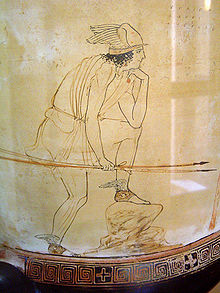
Portrait of the Greek actor Euiaon in Sophocles' Andromeda, c. 430 BC.
Sophocles is known for innovations in dramatic construction; deeper development of characters than earlier playwrights;[7] and, if information technology was not Aeschylus, the addition of a third actor,[33] which farther reduced the role of the chorus, and increased opportunities for development and conflict.[seven] Aeschylus, who dominated Athenian playwriting during Sophocles' early career, adopted the third actor into his own work.[7] Also the 3rd actor, Aristotle credits Sophocles with the introduction of skenographia, or scenery-painting; but this too is attributed elsewhere to someone else (by Vitruvius, to Agatharchus of Samos).[33] Afterward Aeschylus died, in 456 BC, Sophocles became the pre-eminent playwright in Athens,[2] winning competitions at eighteen Dionysia, and 6 Lenaia festivals.[two] His reputation was such that foreign rulers invited him to nourish their courts; but, unlike Aeschylus, who died in Sicily, or Euripides, who spent time in Macedon, Sophocles never accustomed any of these invitations.[2] Aristotle, in his Poetics (c. 335 BC), used Sophocles' Oedipus King as an example of the highest achievement in tragedy.[34]
Only two of the seven surviving plays[35] can be dated securely: Philoctetes to 409 BC, and Oedipus at Colonus to 401 BC (staged afterward his death, by his grandson). Of the others, Electra shows stylistic similarities to these two, suggesting that it was probably written in the later part of his career; Ajax, Antigone, and The Trachiniae, are by and large thought early, again based on stylistic elements; and Oedipus Male monarch is put in a middle flow. Most of Sophocles' plays show an undercurrent of early fatalism, and the beginnings of Socratic logic as a mainstay for the long tradition of Greek tragedy.[36] [37]
Theban plays [edit]
The Theban plays comprise three plays: Oedipus Rex (also chosen Oedipus Tyrannus or Oedipus the Male monarch), Oedipus at Colonus, and Antigone. All three concern the fate of Thebes during and after the reign of Rex Oedipus.[38] They have oft been published under a unmarried encompass;[39] but Sophocles wrote them for divide festival competitions, many years apart. The Theban plays are not a proper trilogy (i.e. iii plays presented as a continuous narrative), nor an intentional serial; they contain inconsistencies.[38] Sophocles also wrote other plays pertaining to Thebes, such as the Epigoni, but simply fragments have survived.[twoscore]
Subjects [edit]
The 3 plays involve the tale of Oedipus, who kills his father and marries his mother, not knowing they are his parents. His family is cursed for three generations.
In Oedipus Rex, Oedipus is the protagonist. His infanticide is planned by his parents, Laius and Jocasta, to prevent him fulfilling a prophecy; but the servant entrusted with the infanticide passes the babe on, through a series of intermediaries, to a childless couple, who adopt him, non knowing his history. Oedipus eventually learns of the Delphic Oracle's prophecy of him, that he would kill his father, and ally his female parent; he attempts to abscond his fate without harming those he knows every bit his parents (at this point, he does not know that he is adopted). Oedipus meets a man at a crossroads accompanied by servants; Oedipus and the man fight, and Oedipus kills the man (who was his begetter, Laius, although neither knew at the fourth dimension). He becomes the ruler of Thebes afterward solving the riddle of the Sphinx and in the process, marries the widowed queen, his female parent Jocasta. Thus the phase is set for horror. When the truth comes out, following from another true but confusing prophecy from Delphi, Jocasta commits suicide, Oedipus blinds himself and leaves Thebes. At the end of the play, social club is restored. This restoration is seen when Creon, brother of Jocasta, becomes king, and too when Oedipus, before going off to exile, asks Creon to take care of his children. Oedipus'south children will always conduct the weight of shame and humiliation because of their father's actions.[41]
In Oedipus at Colonus, the banished Oedipus and his daughter Antigone arrive at the town of Colonus where they run into Theseus, Rex of Athens. Oedipus dies and strife begins betwixt his sons Polyneices and Eteocles. They fight, and simultaneously run each other through.
In Antigone, the protagonist is Oedipus' daughter, Antigone. She is faced with the choice of allowing her brother Polyneices' trunk to remain unburied, outside the urban center walls, exposed to the ravages of wild fauna, or to bury him and face up death. The male monarch of the land, Creon, has forbidden the burial of Polyneices for he was a traitor to the city. Antigone decides to bury his body and confront the consequences of her deportment. Creon sentences her to death. Eventually, Creon is convinced to gratuitous Antigone from her penalty, but his decision comes too tardily and Antigone commits suicide. Her suicide triggers the suicide of two others close to King Creon: his son, Haemon, who was to wed Antigone, and his wife, Eurydice, who commits suicide after losing her merely surviving son.
Limerick and inconsistencies [edit]

The plays were written across thirty-vi years of Sophocles' career and were not composed in chronological order, but instead were written in the order Antigone, Oedipus Rex, and Oedipus at Colonus. Nor were they composed every bit a trilogy – a group of plays to exist performed together, but are the remaining parts of three different groups of plays. Equally a result, there are some inconsistencies: notably, Creon is the undisputed rex at the cease of Oedipus King and, in consultation with Apollo, single-handedly makes the decision to expel Oedipus from Thebes. Creon is also instructed to wait later on Oedipus' daughters Antigone and Ismene at the stop of Oedipus Rex. By dissimilarity, in the other plays there is some struggle with Oedipus' sons Eteocles and Polynices in regard to the succession. In Oedipus at Colonus, Sophocles attempts to piece of work these inconsistencies into a coherent whole: Ismene explains that, in light of their tainted family lineage, her brothers were at first willing to cede the throne to Creon. Nonetheless, they eventually decided to take accuse of the monarchy, with each brother disputing the other's right to succeed. In addition to being in a clearly more powerful position in Oedipus at Colonus, Eteocles and Polynices are as well culpable: they consent (l. 429, Theodoridis, tr.) to their begetter's going to exile, which is one of his bitterest charges confronting them.[38]
Other plays [edit]
In addition to the three Theban plays, at that place are iv surviving plays by Sophocles: Ajax, Women of Trachis, Electra, and Philoctetes, the last of which won first prize in 409 BC.[42]
Ajax focuses on the proud hero of the Trojan War, Telamonian Ajax, who is driven to treachery and eventually suicide. Ajax becomes gravely upset when Achilles' armor is presented to Odysseus instead of himself. Despite their enmity toward him, Odysseus persuades the kings Menelaus and Agamemnon to grant Ajax a proper burial.
The Women of Trachis (named for the Trachinian women who make upward the chorus) dramatizes Deianeira'due south accidentally killing Heracles later on he had completed his famous twelve labors. Tricked into thinking it is a love charm, Deianeira applies poison to an article of Heracles' clothing; this poisoned robe causes Heracles to die an excruciating death. Upon learning the truth, Deianeira commits suicide.
Electra corresponds roughly to the plot of Aeschylus' Cooler Bearers. It details how Electra and Orestes avenge their father Agamemnon's murder by Clytemnestra and Aegisthus.
Philoctetes retells the story of Philoctetes, an archer who had been abandoned on Lemnos past the residuum of the Greek armada while on the way to Troy. After learning that they cannot win the Trojan War without Philoctetes' bow, the Greeks transport Odysseus and Neoptolemus to retrieve him; due to the Greeks' earlier treachery, however, Philoctetes refuses to rejoin the army. It is only Heracles' deus ex machina advent that persuades Philoctetes to go to Troy.
Fragmentary plays [edit]
Although over 120 titles of plays associated with Sophocles are known and presented beneath,[43] little is known of the precise dating of most of them. Philoctetes is known to have been written in 409 BC, and Oedipus at Colonus is known to take only been performed in 401 BC, posthumously, at the initiation of Sophocles' grandson. The convention on writing plays for the Greek festivals was to submit them in tetralogies of three tragedies along with i satyr play. Forth with the unknown dating of the vast majority of over 120 plays, it is also largely unknown how the plays were grouped. It is, even so, known that the three plays referred to in the modern era as the "Theban plays" were never performed together in Sophocles' own lifetime, and are therefore non a trilogy (which they are sometimes erroneously seen as).
Fragments of Ichneutae (Tracking Satyrs) were discovered in Arab republic of egypt in 1907.[44] These amount to about half of the play, making it the best preserved satyr play after Euripides' Cyclops, which survives in its entirety.[44] Fragments of the Epigoni were discovered in April 2005 by classicists at Oxford University with the help of infrared technology previously used for satellite imaging. The tragedy tells the story of the 2d siege of Thebes.[40] A number of other Sophoclean works have survived but in fragments, including:
Sophocles' view of his ain work [edit]
There is a passage of Plutarch's tract De Profectibus in Virtute 7 in which Sophocles discusses his own growth every bit a author. A likely source of this material for Plutarch was the Epidemiae of Ion of Chios, a book that recorded many conversations of Sophocles; only a Hellenistic dialogue well-nigh tragedy, in which Sophocles appeared as a character, is also plausible.[45] The onetime is a likely candidate to accept contained Sophocles' discourse on his ain development because Ion was a friend of Sophocles, and the book is known to accept been used by Plutarch.[46] Though some interpretations of Plutarch'south words suggest that Sophocles says that he imitated Aeschylus, the translation does non fit grammatically, nor does the interpretation that Sophocles said that he was making fun of Aeschylus' works. C. M. Bowra argues for the following translation of the line: "After practising to the full the bigness of Aeschylus, then the painful ingenuity of my own invention, now in the third phase I am changing to the kind of diction which is most expressive of graphic symbol and best."[47]
Here Sophocles says that he has completed a stage of Aeschylus' piece of work, meaning that he went through a phase of imitating Aeschylus' style simply is finished with that. Sophocles' opinion of Aeschylus was mixed. He certainly respected him plenty to imitate his piece of work early on in his career, merely he had reservations about Aeschylus' way,[48] and thus did not go along his false upward. Sophocles' first stage, in which he imitated Aeschylus, is marked by "Aeschylean pomp in the linguistic communication".[49] Sophocles' second stage was entirely his ain. He introduced new ways of evoking feeling out of an audience, as in his Ajax, when Ajax is mocked by Athene, then the stage is emptied then that he may commit suicide alone.[50] Sophocles mentions a 3rd stage, distinct from the other 2, in his give-and-take of his development. The third stage pays more heed to wording. His characters spoke in a way that was more natural to them and more expressive of their individual character feelings.[51]
Namesake [edit]
- Sophocles (crater), a crater on Mercury.
See also [edit]
- Theatre of aboriginal Greece
Notes [edit]
- ^ Jones, Daniel; Roach, Peter, James Hartman and Jane Setter, eds. Cambridge English Pronouncing Lexicon. 17th edition. Cambridge Upward, 2006.
- ^ a b c d eastward f k h i j Sommerstein (2002), p. 41.
- ^ The exact number is unknown, the Suda says he wrote 123, another ancient source says 130, but no verbal number "is possible", see Lloyd-Jones 2003, p. iii.
- ^ Suda (ed. Finkel et al.): s.v. Σοφοκλῆς .
- ^ Sophocles at the Encyclopædia Britannica
- ^ LLoyd-Jones, H. (ed. and trans.) (1997). Introduction, in Sophocles I . Sophocles. Cambridge, Massachusetts; London, England: Loeb Classical Library, Harvard Academy Press. p. 9. ISBN9780674995574.
- ^ a b c d Freeman, p. 247.
- ^ a b c Sommerstein (2007), p. xi.
- ^ Lloyd-Jones 1994, p. 7.
- ^ Freeman, p. 246.
- ^ Life of Cimon viii. Plutarch is mistaken about Aeschylus' death during this trip; he went on to produce dramas in Athens for another decade.
- ^ McGraw-Hill Encyclopedia of World Drama: An International Reference Work in five Volumes, Volume 1, "Sophocles".
- ^ Beer 2004, p. 69.
- ^ Lloyd-Jones 1994, p. 12.
- ^ a b Lloyd-Jones 1994, p. 13.
- ^ Clinton, Kevin "The Epidauria and the Arrival of Asclepius in Athens", in Ancient Greek Cult Practice from the Epigraphical Evidence, edited past R. Hägg, Stockholm, 1994.
- ^ Lloyd-Jones 1994, pp. 12–13.
- ^ Schultz 1835, pp. 150–51.
- ^ Lucas 1964, p. 128.
- ^ Cicero recounts this story in his De Senectute seven.22.
- ^ Sommerstein (2002), pp. 41–42.
- ^ a b Athenaeus (2011). The Learned Banqueters, Volume VII. Douglas Olson, S. (ed. and trans.). Cambridge, Massachusetts; London, England: Loeb Classical Library, Harvard Academy Press. p. 53. ISBN9780674996731.
- ^ Athenaeus (1854). The Deipnosophists. Attalus.org. XIII. Translated past Yonge, Charles Knuckles. London: Henry M. Bohn. pp. 603–four. LCCN 2002554451. Retrieved 24 April 2021.
- ^ a b Athenaeus (2011). The Learned Banqueters, Volume VII. Douglas Olson, S. (ed. and trans.). Cambridge, Massachusetts; London, England: Loeb Classical Library, Harvard University Printing. p. 52. ISBN9780674996731.
- ^ Athenaeus (2011). The Learned Banqueters, Volume VII. Douglas Olson, Due south. (ed. and trans.). Cambridge, Massachusetts; London, England: Loeb Classical Library, Harvard University Press. pp. 56–57. ISBN9780674996731.
- ^ Fortenbaugh, William Wall. Lyco and Traos and Hieronymus of Rhodes: Text, Translation, and Give-and-take. Transaction Publishers (2004). ISBN 978-one-4128-2773-7. p. 161
- ^ Athenaeus (2011). The Learned Banqueters, Book 7. Douglas Olson, S. (ed. and trans.). Cambridge, Massachusetts; London, England: Loeb Classical Library, Harvard University Printing. p. 57. ISBN9780674996731.
- ^ Athenaeus (2011). The Learned Banqueters, Volume VII. Douglas Olson, Southward. (ed. and trans.). Cambridge, Massachusetts; London, England: Loeb Classical Library, Harvard University Press. p. 56. ISBN9780674996731.
- ^ Sophocles (1992). Greek Lyric, Volume Iv: Bacchylides, Corinna, and Others. Campbell, D. A. (ed. and trans.). Cambridge, Massachusetts; London, England: Loeb Classical Library, Harvard University Press. p. 333. ISBN9780674995086.
- ^ Sophocles (1992). Greek Lyric, Volume IV: Bacchylides, Corinna, and Others. Campbell, D. A. (ed. and trans.). Cambridge, Massachusetts; London, England: Loeb Classical Library, Harvard University Press. p. 332. ISBN9780674995086.
- ^ Athenaeus (2011). The Learned Banqueters, Volume VII. Douglas Olson, Southward. (ed. and trans.). Cambridge, Massachusetts; London, England: Loeb Classical Library, Harvard University Press. p. 58. ISBN9780674996731.
- ^ Athenaeus (2011). The Learned Banqueters, Volume VII. Douglas Olson, S. (ed. and trans.). Cambridge, Massachusetts; London, England: Loeb Classical Library, Harvard Academy Press. p. 59. ISBN9780674996731.
- ^ a b Lloyd-Jones 1994, p. 9.
- ^ Aristotle. Ars Poetica.
- ^ The first printed edition of the vii plays is past Aldus Manutius in Venice 1502: Sophoclis tragaediae [sic] septem cum commentariis. Despite the addition 'cum commentariis' in the title, the Aldine edition did non include the ancient scholia to Sophocles. These had to look until 1518 when Janus Lascaris brought out the relevant edition in Rome.
- ^ Lloyd-Jones 1994, pp. 8–9.
- ^ Scullion, pp. 85–86, rejects attempts to date Antigone to presently before 441/0 based on an anecdote that the play led to Sophocles' election as general. On other grounds, he cautiously suggests c. 450 BC.
- ^ a b c Sophocles, ed Grene and Lattimore, pp. ane–2.
- ^ See for instance: "Sophocles: The Theban Plays", Penguin Books, 1947; Sophocles I: Oedipus the King, Oedipus at Colonus, Antigone, University of Chicago, 1991; Sophocles: The Theban Plays: Antigone/King Oidipous/Oidipous at Colonus, Focus Publishing/R. Pullins Company, 2002; Sophocles, The Oedipus Bicycle: Oedipus Rex, Oedipus at Colonus, Antigone, Harvest Books, 2002; Sophocles, Works, Loeb Classical Library, Vol I. London, Westward. Heinemann; New York, Macmillan, 1912 (often reprinted) – the 1994 Loeb, notwithstanding, prints Sophocles in chronological order.
- ^ a b Murray, Matthew, "Newly Readable Oxyrhynchus Papyri Reveal Works by Sophocles, Lucian, and Others Archived 11 April 2006 at the Wayback Car", Theatermania, xviii April 2005. Retrieved 9 July 2007.
- ^ Sophocles. Oedipus the King. The Norton Anthology of Western Literature. Gen. ed. Peter Simon. 8th ed. Vol. 1. New York: Norton, 1984. 648–52. Print. ISBN 0-393-92572-2
- ^ Freeman, pp. 247–48.
- ^ Lloyd-Jones 2003, pp. 3–9.
- ^ a b Seaford, p. 1361.
- ^ Sophocles (1997). Sophocles I. Lloyd-Jones, H. (ed. and trans.). Cambridge, MA; London, England: Loeb Classical Library, Harvard University Press. p. 11. ISBN9780674995574.
- ^ Bowra, p. 386.
- ^ Bowra, p. 401.
- ^ Bowra, p. 389.
- ^ Bowra, p. 392.
- ^ Bowra, p. 396.
- ^ Bowra, pp. 385–401.
References [edit]
- Beer, Josh (2004). Sophocles and the Tragedy of Athenian Democracy. Greenwood Publishing. ISBN 0-313-28946-8
- Bowra, C.M. (1940). "Sophocles on His Own Development". American Journal of Philology. 61 (4): 385–401. doi:10.2307/291377. JSTOR 291377.
- Finkel, Raphael. "Adler number: sigma,815". Suda on Line: Byzantine Lexicography . Retrieved 14 March 2007.
- Freeman, Charles. (1999). The Greek Achievement: The Foundation of the Western Earth. New York: Viking Printing. ISBN 0-670-88515-0
- Hubbard, Thomas Grand. (2003). Homosexuality in Greece and Rome: A Sourcebook of Bones Documents.
- Johnson, Marguerite & Terry Ryan (2005). Sexuality in Greek and Roman Gild and Literature: A Sourcebook. Routledge. ISBN 0-415-17331-0, 978-0-415-17331-five
- Lloyd-Jones, Hugh & Wilson, Nigel Guy (ed.) (1990). Sophoclis: Fabulae. Oxford Classical Texts.
- Lloyd-Jones, Hugh (ed.) (1994). Sophocles: Ajax. Electra. Oedipus Tyrannus. Edited and translated by Hugh Lloyd-Jones, Loeb Classical Library No. 20.
- Lloyd-Jones, Hugh (ed.) (1994). Sophocles: Antigone. The Women of Trachis. Philoctetes. Oedipus at Colonus. Edited and translated past Hugh Lloyd-Jones, Loeb Classical Library No. 21.
- Lloyd-Jones, Hugh (ed.) (1996). Sophocles: Fragments. Edited and translated past Hugh Lloyd-Jones, Loeb Classical Library No. 483.
- Lucas, Donald William (1964). The Greek Tragic Poets. W.West. Norton & Co.
- Plato. Plato in Twelve Volumes, Vols. 5 & 6 translated by Paul Shorey. Cambridge, MA, Harvard Academy Press; London, William Heinemann Ltd. 1969.
- Schultz, Ferdinand (1835). De vita Sophoclis poetae commentatio. Phil. Diss., Berlin.
- Scullion, Scott (2002). Tragic dates, Classical Quarterly, new sequence 52, pp. 81–101.
- Seaford, Richard A. S. (2003). "Satyric drama". In Simon Hornblower and Antony Spawforth (ed.). The Oxford Classical Lexicon (revised 3rd ed.). Oxford: Oxford University Printing. p. 1361. ISBN978-0-nineteen-860641-three.
- Smith, Philip (1867). "Sophocles". In William Smith (ed.). Dictionary of Greek and Roman Biography and Mythology. Vol. 3. Boston: Little, Brown, and Company. pp. 865–73. Archived from the original on 2 February 2007. Retrieved xix February 2007.
- Sommerstein, Alan Herbert (2002). Greek Drama and Dramatists. Routledge. ISBN 0-415-26027-2
- Sommerstein, Alan Herbert (2007). "Full general Introduction" pp. eleven–xxix in Sommerstein, A.H., Fitzpatrick, D. and Tallboy, T. Sophocles: Selected Fragmentary Plays: Volume i. Aris and Phillips. ISBN 0-85668-766-ix
- Sophocles. Sophocles I: Oedipus the King, Oedipus at Colonus, Antigone. 2nd ed. Grene, David and Lattimore, Richard, eds. Chicago: Academy of Chicago, 1991.
- Encyclopædia Britannica, Inc. "Macropaedia Knowledge In Depth." The New Encyclopædia Britannica Volume 20. Chicago: Encyclopædia Britannica, Inc., 2005. 344–46.
External links [edit]
 | Wikiquote has quotations related to: Sophocles |
 | Wikimedia Commons has media related to Sophocles. |
- Works by Sophocles at Projection Gutenberg
- Works by Sophocles at Faded Page (Canada)
- Works past or about Sophocles at Internet Archive
- Works by Sophocles at LibriVox (public domain audiobooks)

- Works past Sophocles at the Perseus Digital Library (Greek and English)
- SORGLL: Sophocles, Electra 1126–1170; read by Rachel Kitzinger
Source: https://en.wikipedia.org/wiki/Sophocles
0 Response to "Again When on a Time Sophocles Who Was His Fellowcommissioner"
Post a Comment